Interrupted: When Presence Became Protection
Sometimes ordinary errands on the ranch become unexpected encounters that change a moment, and sometimes even a life.
Sometimes an interruption changes the course of a day, even a life.
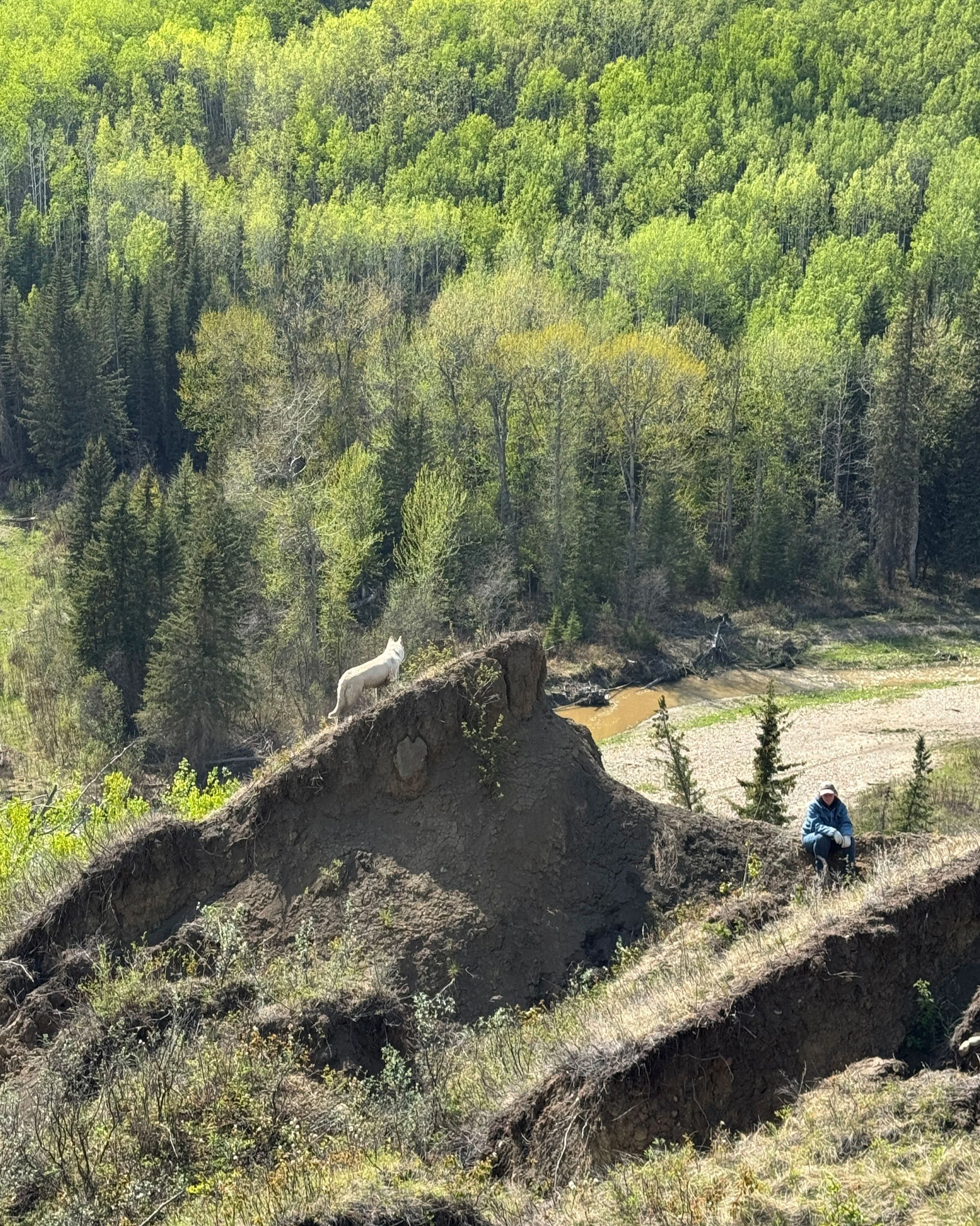
On our ranch, our paths often cross with those of the wild.
One sunny day, with only a light wind moving through the grass, we set out on horseback. Even the horses seemed glad to leave their fences behind and head toward the river hills that frame our ranch.
We rounded a bend in the trail, and a short distance ahead, a mother moose and her calf trotted toward us.
We stopped. She slowed, then veered off the path and into the forest, her calf close behind.
Her being there, on that path, in that moment—
felt almost deliberate.
We waited a few moments, then continued down the trail.
Within seconds, a bear rounded the corner.
He moved with purpose, steady and intent. At first, he did not notice us.
But our horses noticed him.
They bobbed their heads and tried to turn away. We spoke their names to steady them and held the reins to keep them from bolting.
At the commotion, the bear stopped abruptly, as though seeing us for the first time. He stared for a moment, then ran into the forest.
Away from us, and away from the mother moose and her calf.
I do not know what might have happened had we not come around that bend when we did. But I have often wondered whether our unexpected arrival changed the course of that moment.
Another spring, we were checking the hayfields to see how the grass and alfalfa had weathered the winter. As we drove the perimeter of one field, we saw a dark shape disappear into the forest, then re-emerge along the same stretch of fence line that marked the boundary between field and trees.
It happened again and again, so we decided to approach. Slowly.
We discovered a mother moose urging her calf to follow her.
But it could not.
Its gangly legs were tangled in the fence.
It could not get free.
We angled the truck toward the wire, using it as a barrier in case the mother moose decided we were too close. We waited for her to slip back into the trees.
When she did, Cam jumped out and freed the calf.
Then he leaped back into the truck as the mother rushed from the forest toward her calf, stopping only when she reached him. She sniffed him, then both disappeared into the trees.
Another spring, while we planted a field, two sparrows began flying unusually close to the tractor. Normally, small birds give wide berth as a tractor rumbles through a field. But that day, they kept drawing near.
Then they landed.
One settled on the hood near the cab. Another landed behind it.
Neither moved.
A hawk flew past the tractor.
Then it circled back.
Again and again, its shadow flashed over the tractor. But the sparrows remained, their little claws clinging to the metal.
For several minutes, the hawk kept pace with the tractor while the sparrows stayed where they were—resting, hiding, finding safety in the most unlikely of places.
They rode along until the hawk finally disappeared. When the sky was clear of danger, they lifted off and went their way.
One night, I was the one who needed an interruption.
It had been a particularly difficult day, and I was desperate for sleep.
But not that night.
A pair of foxes had taken up residence near the yard, and they seemed determined to express every thought they had into the night air. In the distance, coyote pups were practicing their howls. Their parents called out, and the pups answered with high little yips and barks.
An owl added its hoot-hoot from the trees.
Our dogs could not resist joining in.
The whole night seemed to have found its voice at once.
The noise drove sleep from me. I lay awake, unable to find relief.
Then a low, deep sound moved through the darkness.
A howl.
The kind that could only come from one animal in our valley.
A wolf.
He was close enough that his call was loud and clear. He howled only once.
And everything went silent.
The coyotes quieted. The foxes stopped calling. The dogs went still. Even the owl stopped hooting.
Silence settled over the yard.
And I smiled.
Such an unexpected interruption.
Yet exactly the one I needed.
A wolf.
Bambi
One night, coyotes came through the pasture. By morning, one small calf was still alive, but badly wounded.
The coyotes’ shadows blended with the night as they traveled in single file on a well-worn path.
With silence, stealth, and gnawing hunger.
At the edge of the forest, hidden among the shrubbery, they paused. Surveying the landscape before them, they sniffed the air for the scent of newborn calves.
Their attention settled on a cow and calf sleeping near the edge of the herd, which rested quietly in the open pasture. With the nimble skill of seasoned hunters, the coyotes spread out—crouching low, surrounding their target.
At the leader’s signal, they shot forward and attacked.
The calf cried out, and the silence was shattered. Mother cows leaped to their feet, calling their calves to their sides. At the edge of the forest, one brave mother charged the predators. Fearless and feral, she lowered her head and rushed at the coyote that had sunk its teeth into her calf’s back leg.
The calf bawled—a desperate cry for help.
Three more cows hurtled into the fray, each targeting a member of the hunting pack. The battle was intense but short. The coyotes were turned back.
As the chaos settled, calves pressed close to their mothers, who stood guard. Alert. Watchful. Ready.
When the coyotes didn’t return, the herd grew still.
All seemed well.
Until it wasn’t.
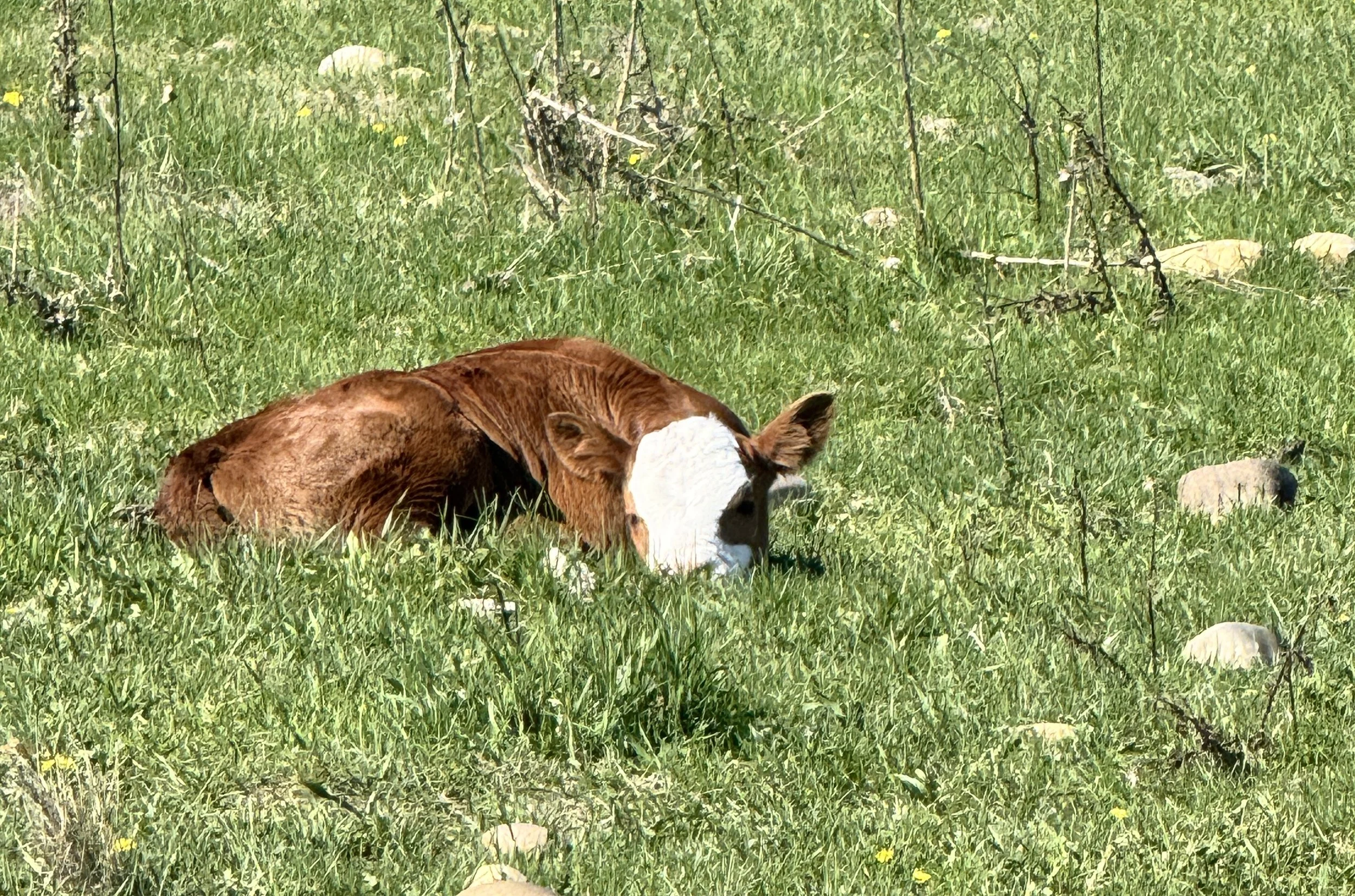
When we found the calf the following morning, his sides were drawn in. When he lifted his head, his ears drooped, and his nose was cracked with dryness. His body bore scratches from the skirmish. We brought him to the barn to rest and rehydrate, hoping to return him to his mom once he recovered.
But he struggled to eat.
When we fed him from a bottle, much of the milk dribbled off his chin and onto the floor. At first, we assumed he needed time to adjust to bottle feeding—but as the struggle continued, we knew something else was wrong.
When we looked inside his mouth, we were startled by what we found. A piece of his tongue was gone, the edge marked by the unmistakable shape of a coyote’s bite. The remaining portion had swollen to nearly three times its normal size.
We transferred the milk from the bottle into a stomach tube, which allowed us to deliver it directly to his stomach.
We named him Bambi.
With a full stomach of warm milk, Bambi lay down and slept.
As his strength returned, we tried the bottle again. At first, feeding Bambi was slow. He mouthed the nipple awkwardly, milk slipping from his chin as he worked to drink without a full tongue. Little by little, he learned to mimic the sucking motion by moving his jaw instead.
After two days, he drank from the bottle, finishing it in minutes.
Through it all, Bambi never made a sound. The damage to his tongue seemed to have affected his voice as well.
But then, one morning, he let out a bright, cheerful call when we brought his bottle.
He had found his voice.
After finishing his milk, he ran around the yard—bucking with pure delight. That summer, Bambi stayed close to the yard, growing stronger by the day. In time, he became a herd sire, fathering calves of his own on the ranch.
Maybe that’s what hope looks like.
One small life.
Changed, but still moving forward.
With what remains.
One day at a time.