A Different Word than Died
When Domyno completed her twenty-seven years of life, I searched for a different word than died. What came was completed—a word that held grief and gratitude together and helped me see how a full life can continue through the stories still being written.
I did not know, when I shared part of Domyno's story, that I would soon be living its final chapter.
Only a short time after I released it, my beautiful Domyno completed her life.
She was twenty-seven years old.
As I've looked through old photographs these past few days, I've realized how deeply she is woven into the story of this ranch—and into mine.
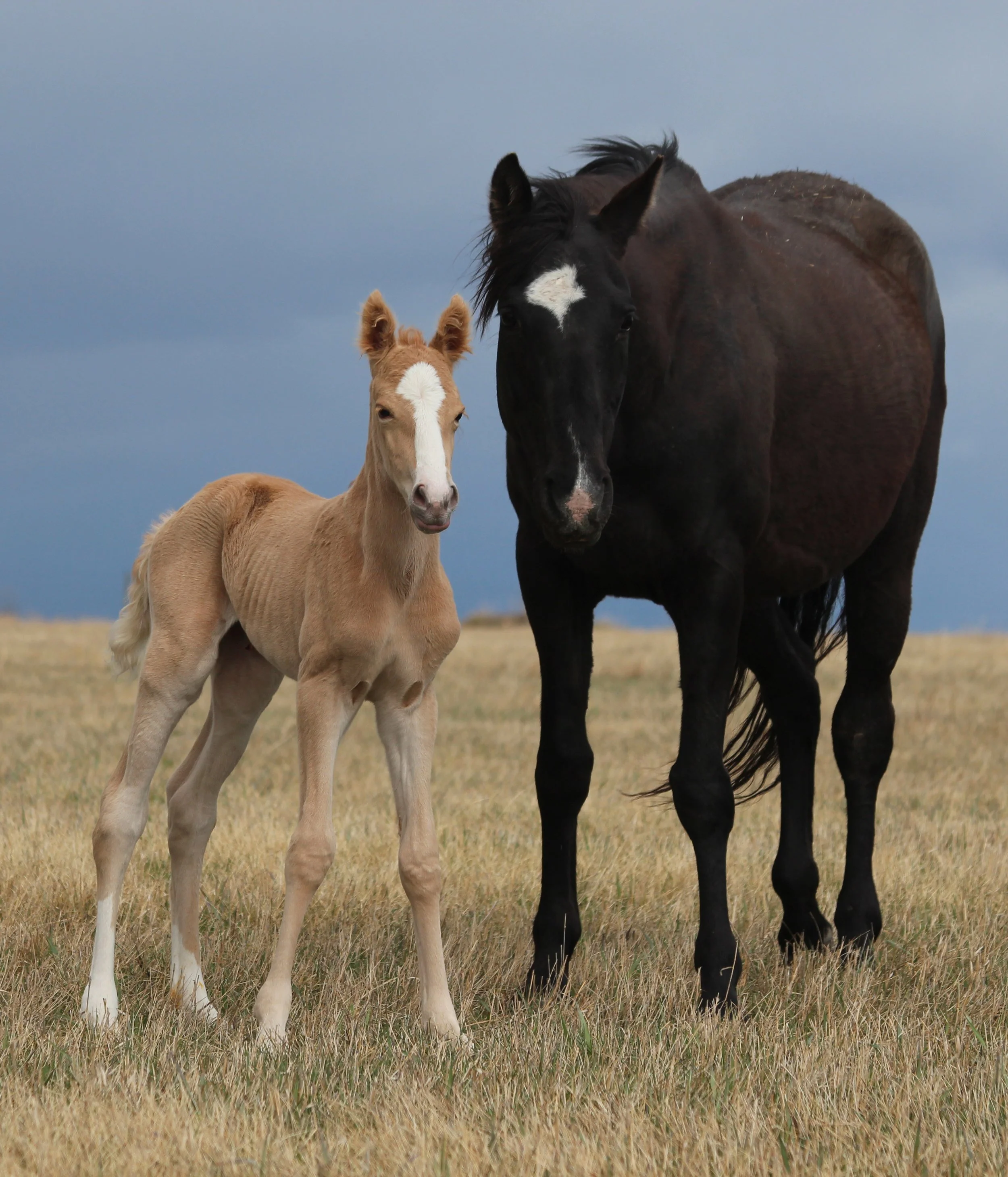
Domyno captured my heart the day she was born.
I wanted to spend as much time with her as I could.
That summer, I took on an extra writing job so I could earn enough to purchase her when she was weaned.
Years ago, writing brought Domyno into my life.
Today, writing helps me tell her story.
It feels like a circle I never could have planned.
Domyno was one of my first riding horses. With her, I began my journey into trick training. But perhaps her greatest gift was teaching me to love new life.
Her first foal was named Indee. Although he wasn't part of my plans, that summer he wobbled into my life on unsteady legs. As he grew in strength, I laughed as he sprinted away from his mom, only to return when she nickered. She was never far away. Watching them together, I fell in love with being part of the unfolding of new life.
Now spring is my second Christmas, as I wait for the new foals to be born.
Domyno gave me this gift. She shaped this part of the story I am still living.
For some time, I sensed her life was drawing toward its completion.
She spent more time resting and quietly watching the world around her.
We spent time together.
Remembering.
Yet I kept hoping. Maybe this wouldn't be the final chapter. There had been other seasons when I thought I might lose her, only to have her recover.
Every day she lived felt like another gift.
On the day she completed her life, she spent it the way she had spent so many others.
Grazing beside Indee.
Stopping for a drink.
Resting in the summer sunshine.
Her life reached its completion in the most ordinary of ways.
That afternoon, as my tears flowed, I searched for a different word than died.
Completed landed in my heart like a soothing balm.
The word carried peace. Not because it made me miss her less, but because it helped me see that there was nothing more to add to her life.
Her chapter was full.
Yet the gifts she gave are still on the ranch.
In Indee. In the other horses that call Domyno mother.
I have shed many tears over the past few days. Even though I tried to prepare for her passing, I wasn't ready.
Are we ever?
Even Indee has been different. Usually, he likes to play tag before I catch him, but after Domyno was gone, he stood quietly beside me. In those first moments, he called for her again and again.
She had been his closest companion since the day he was born.
As I look through the old photographs, I realize that although her life reached its completion, her influence has not diminished.
Her story is complete.
Its influence isn't.
It echoes through the stories still being written.
In every descendant of hers that grazes these pastures.
In every spring morning that fills me with anticipation as I wait for new foals.
In every lesson she taught me.
Even in these words.
Writing brought Domyno into my life.
Now, writing is one way her life continues to touch others.
Her chapter can be complete while its influence continues to unfold.
I wonder if there's a reason we have two hands.
One to hold grief.
The other to hold gratitude.
Today, I hold both.
Tears for the mare I miss.
Smiles for the stories we shared.
Twenty-seven years is a long time.
Yet it doesn't seem long enough.
Domyno's life is complete.
But the hope she left behind still walks through these pastures.
Next spring, I'll wait again for new life to emerge from hidden places. Another granddaughter or grandson of Domyno will take a first breath.
And somewhere in the quiet waiting, I will remember the mare who first taught me to love new life.
If you’d like the fuller story of Domyno and her foals, born 18 years apart, you can find it here.
Not Part of the Plan
Twice, my plans for one horse were interrupted. Both times, a year later, a black foal stood beside her.
Twice, my plans for one horse were interrupted.
The first time, she was beginning her training.
The second time, she was supposed to be retired.
Both times, I thought the interruption had changed the story for the worse.
Both times, a year later, a black foal stood beside her.
The mare’s name was Domyno.
She was jet-black with a bold white star on her forehead. While she was still young, I had already planned the years we would spend together—riding, chasing cows, and exploring the river hills.
Then one night, the neighbour’s stallion got out.
In the morning, we discovered which mare he had chosen.
Domyno.
I was devastated.
Three years of planning. Dreaming.
Gone.
Or at least, that’s what I thought.
For a few minutes, my emotions churned, and I couldn’t approach Domyno. I didn't want to take my frustration out on her; it wasn't her fault. I eventually picked up a brush and started to groom her. The rhythmic brushing helped me come to terms with what occurred. We would face whatever came next together.
Still, I hoped there would be no baby.
As the months passed, her belly grew larger and rounder. By spring, there would be a foal.
Domyno gave birth to a black colt with a bold white blaze and white socks.
We named him Indee.
I waited impatiently for Domyno to raise her colt so that we could wean him, and she and I could get back to the business of riding. At the time, Indee seemed more like an interruption than a gift.
I had no idea what he would become.
He grew into one of our family’s main riding horses, excelling especially at cattle work. He could stop a cow in its tracks with a flick of his tail while quietly guiding another toward a different gate with the angle of his neck.
Even now, Indee loves to play tag before he is caught. Bring out a cookie, though, and the game quickly becomes “Feed me another one.”
Eighteen years after Indee was born, Domyno was retired. I had decided to let her spend the rest of her days peacefully on the ranch.
Then our stallion got out, and a small group of horses escaped with him.
Including Domyno.
Once again, I was concerned.
By then, Domyno was twenty-one. She had proven herself to be an exceptional mother. My concern wasn’t that she couldn’t raise another foal.
It was that she had already done enough.
After years of riding and raising foals, she had earned a quiet retirement.
Now, once again, my plans changed.
Over the next year, I watched her closely, giving her extra oats and hoping she wouldn’t foal again.
But once again, her belly grew round.
Spring would bring another baby.
Exactly one year after the horses got out, Domyno gave birth to a jet-black filly.
We named her Esperanza, the Spanish word for hope.
Now, five years after Esperanza’s birth, Domyno is twenty-seven, with grey flecks in her hair. She is doing well.
Indee is semi-retired.
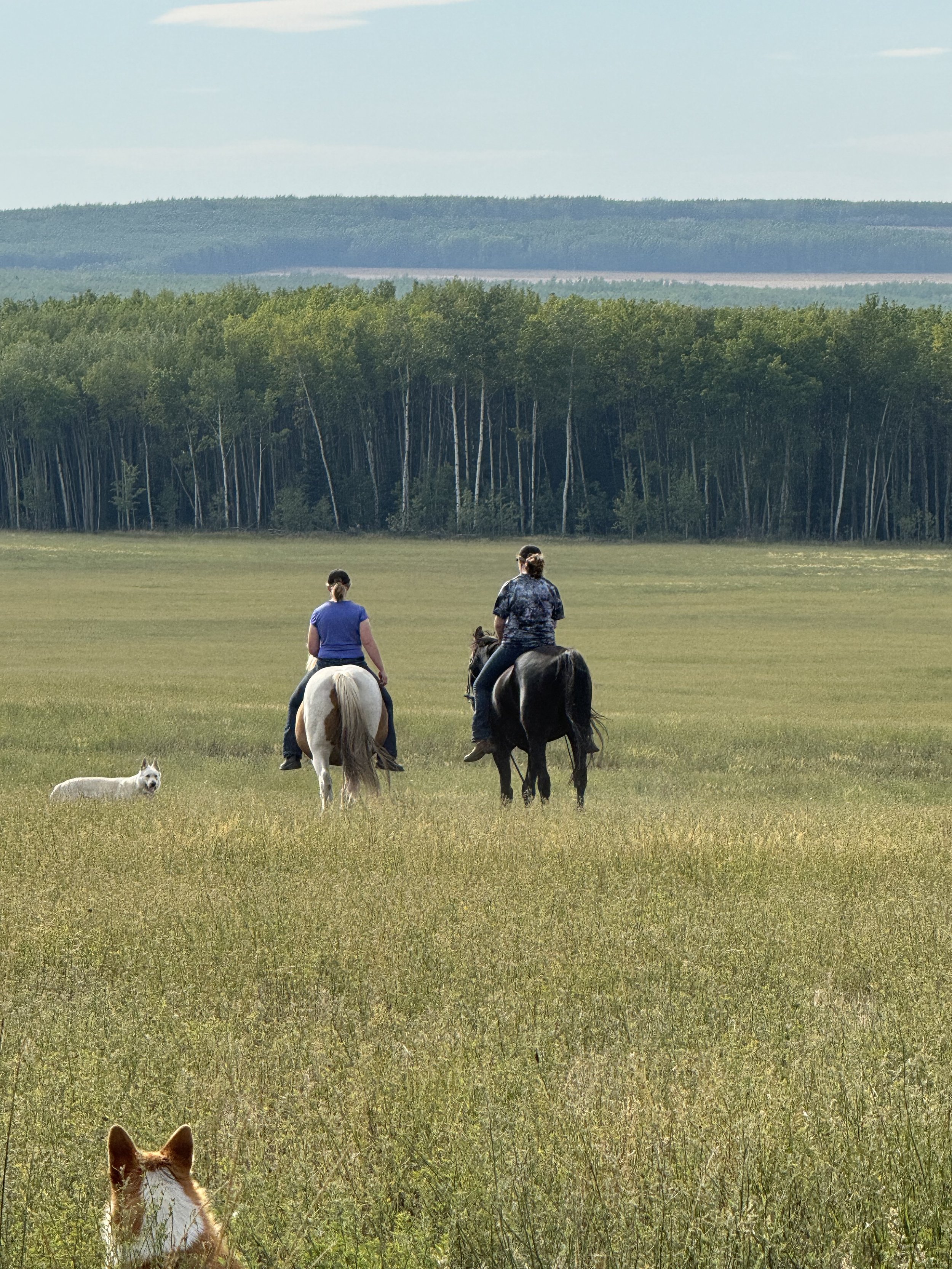
They spend their days resting and grazing together. If we take Indee out for a ride, Domyno waits at the gate for him. When he returns, her whinny is the first thing to greet him.
These days, when I go looking for Domyno, I almost always find Indee nearby, grazing quietly beside her.
Esperanza isn’t far away, growing into the next chapter of the story.
Neither of them was supposed to be part of this story.
I can’t imagine it without them now.
Bambi
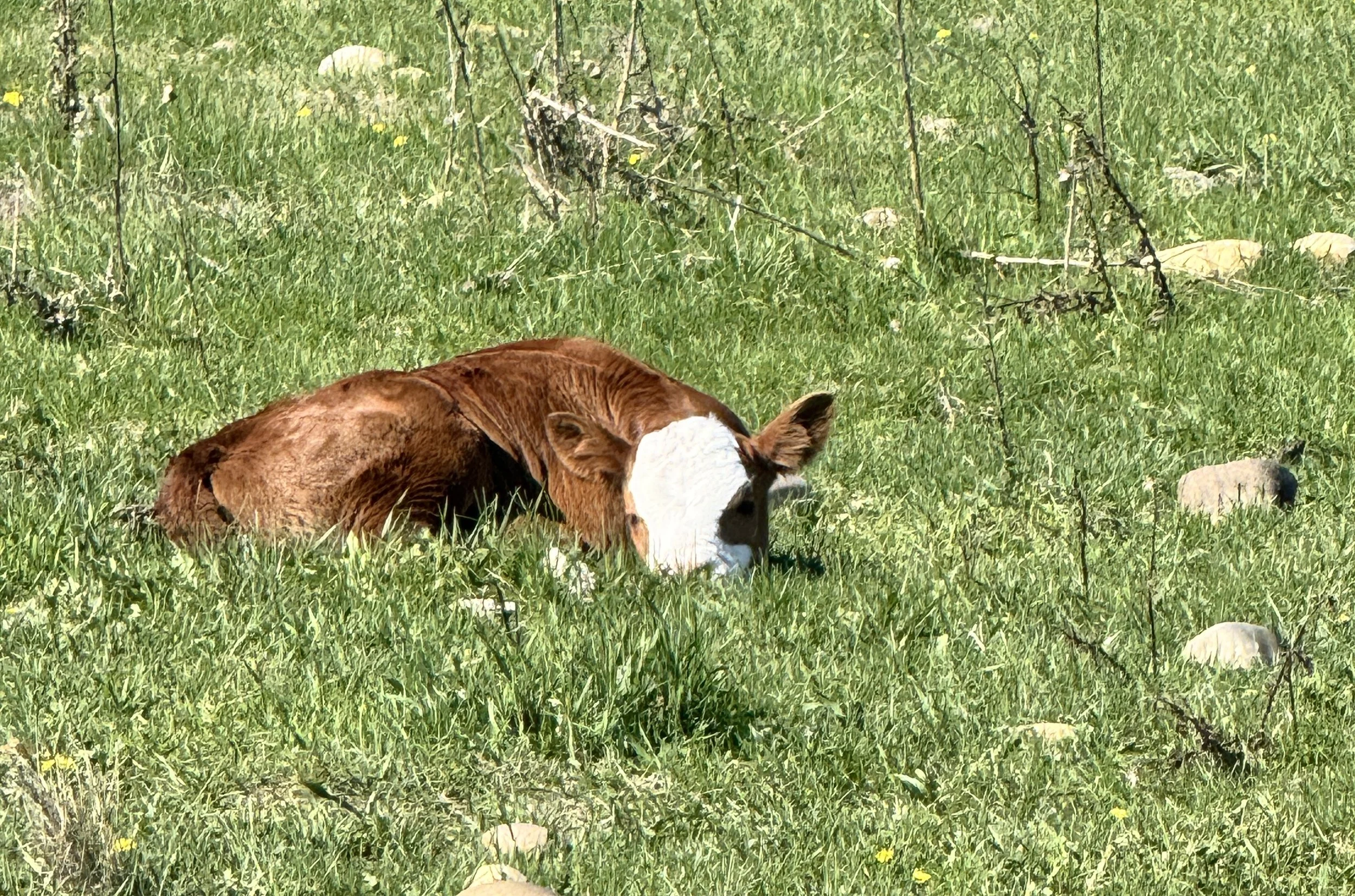
One night, coyotes came through the pasture. By morning, one small calf was still alive, but badly wounded.
The coyotes’ shadows blended with the night as they traveled in single file on a well-worn path.
With silence, stealth, and gnawing hunger.
At the edge of the forest, hidden among the shrubbery, they paused. Surveying the landscape before them, they sniffed the air for the scent of newborn calves.
Their attention settled on a cow and calf sleeping near the edge of the herd, which rested quietly in the open pasture. With the nimble skill of seasoned hunters, the coyotes spread out—crouching low, surrounding their target.
At the leader’s signal, they shot forward and attacked.
The calf cried out, and the silence was shattered. Mother cows leaped to their feet, calling their calves to their sides. At the edge of the forest, one brave mother charged the predators. Fearless and feral, she lowered her head and rushed at the coyote that had sunk its teeth into her calf’s back leg.
The calf bawled—a desperate cry for help.
Three more cows hurtled into the fray, each targeting a member of the hunting pack. The battle was intense but short. The coyotes were turned back.
As the chaos settled, calves pressed close to their mothers, who stood guard. Alert. Watchful. Ready.
When the coyotes didn’t return, the herd grew still.
All seemed well.
Until it wasn’t.
When we found the calf the following morning, his sides were drawn in. When he lifted his head, his ears drooped, and his nose was cracked with dryness. His body bore scratches from the skirmish. We brought him to the barn to rest and rehydrate, hoping to return him to his mom once he recovered.
But he struggled to eat.
When we fed him from a bottle, much of the milk dribbled off his chin and onto the floor. At first, we assumed he needed time to adjust to bottle feeding—but as the struggle continued, we knew something else was wrong.
When we looked inside his mouth, we were startled by what we found. A piece of his tongue was gone, the edge marked by the unmistakable shape of a coyote’s bite. The remaining portion had swollen to nearly three times its normal size.
We transferred the milk from the bottle into a stomach tube, which allowed us to deliver it directly to his stomach.
We named him Bambi.
With a full stomach of warm milk, Bambi lay down and slept.
As his strength returned, we tried the bottle again. At first, feeding Bambi was slow. He mouthed the nipple awkwardly, milk slipping from his chin as he worked to drink without a full tongue. Little by little, he learned to mimic the sucking motion by moving his jaw instead.
After two days, he drank from the bottle, finishing it in minutes.
Through it all, Bambi never made a sound. The damage to his tongue seemed to have affected his voice as well.
But then, one morning, he let out a bright, cheerful call when we brought his bottle.
He had found his voice.
After finishing his milk, he ran around the yard—bucking with pure delight. That summer, Bambi stayed close to the yard, growing stronger by the day. In time, he became a herd sire, fathering calves of his own on the ranch.
Maybe that’s what hope looks like.
One small life.
Changed, but still moving forward.
With what remains.
One day at a time.
The Circle that Held
One summer morning, our mares formed a quiet circle around one of their own. Even our stallion wasn’t invited in. What unfolded became an unexpected lesson about presence, protection and the strength in standing together.
The vibrancy of some moments grows with time, and time itself reveals the depth of richness held within the heart of a mystery.
I didn’t know that on a June morning, watching horses from my kitchen window, I was standing on the edge of one.
Most summers, June is when we put a select group of mares with a stallion so that the following May, there will be a new group of foals. This herd had been together for about a week and had settled with little trouble.
Except for this morning.
Sipping my coffee, I watched an odd scene unfold before me.
One mare rested beside a sandstone-coloured rock, while the others encircled her like sentries, standing guard against any disruption.
The disruption they were shielding her from was Diamond, our herd sire.
Experienced and gentle with his mares, Diamond often got along with his herd. But this morning, something had shifted. Every time he attempted to enter the circle, the mares pinned back their ears as if to say—
Don’t even try.
Diamond read their energy and retreated, only to try again from another place.
Every attempt was thwarted.
The mares held their ground.
I looked back at the rock and saw a flash of movement.
Just a flicker.
Like the swish of a tail.
The rock was not a rock at all.
It was a newborn foal.
One of our mares had given birth in the night, and the others had formed a protective circle around mother and baby. The new mother rested inside that haven, fully trusting the mares to keep her and her foal safe.
And they did not fail her.
I went out to check on them. Both mare and foal were doing well. In time, we introduced Diamond to his son—a golden colt we named Duke.
As Duke grew, he became fast friends with his father and eventually followed in his footsteps, becoming the sire of many horses on our ranch.
Years passed. Duke’s sons and daughters became a significant part of our herd.
These horses carry a gentle quality of heart.
A kind attentiveness.
A willingness to draw near.
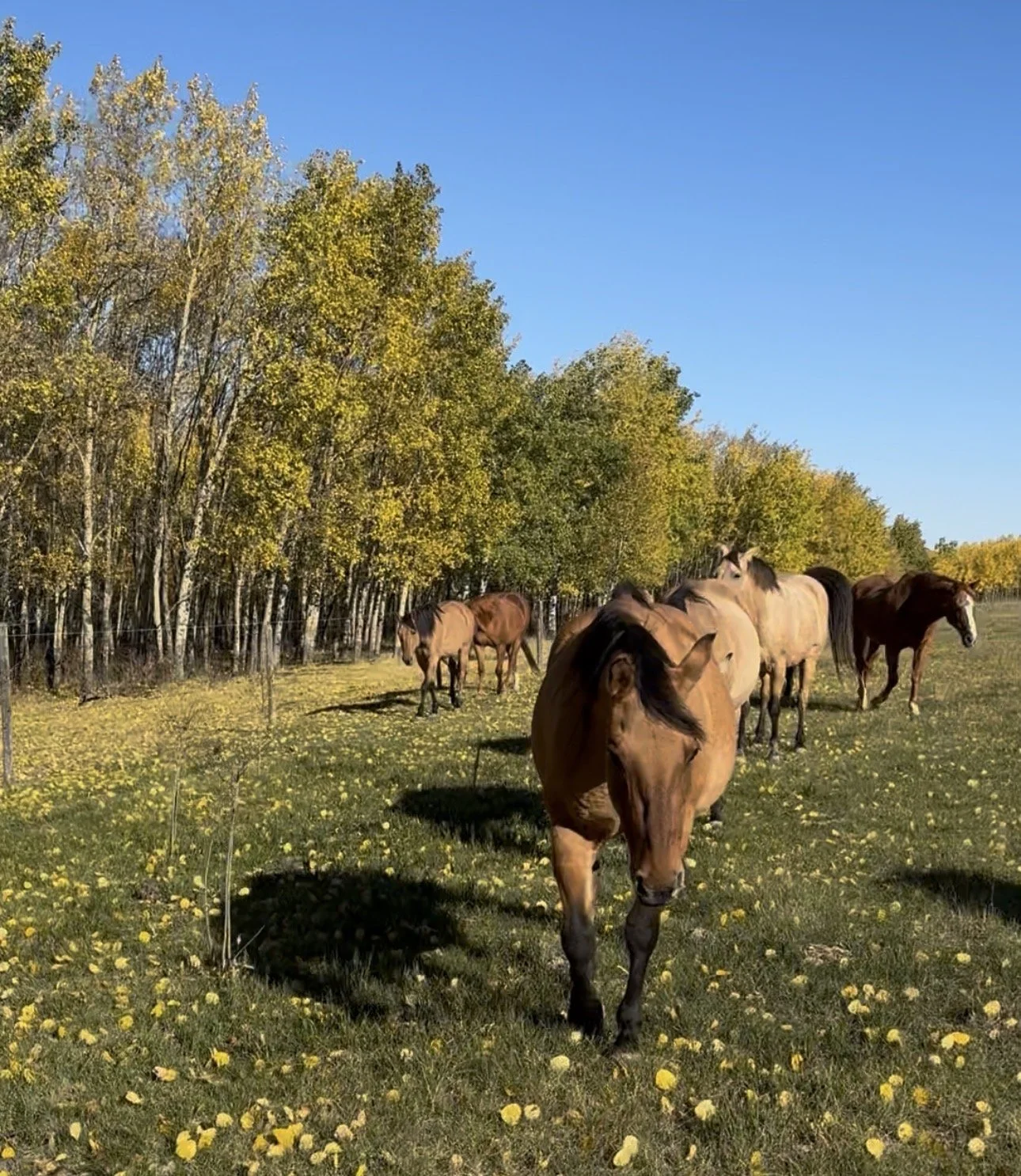
It is not uncommon to walk out into the pasture and have a few fall quietly into step beside me.
But one day, I experienced the full depth of what they carry.
It was a particularly hard season. Much around me was unraveling, and I was helpless to stop it. The shifts and changes felt less like transitions and more like ruptures—fractures moving through the landscape of the ranch and through my own story. Life would not look the same on the other side, and I could not yet see what that place held.
The pain I carried that day was deeper than words. So I went out to the horse pasture, leaned against a fence post, and let myself cry.
The tears came freely.
Then I felt a nudge at my elbow.
I looked up.
The horses—many of them direct descendants of Duke—had formed two quiet semicircles around me. They stood still, heads lowered toward the ground, holding space for my overwhelm without asking anything of me.
For a long while, I stayed inside that circle and simply received.
When I finally stood and moved away from the fence, the horses formed one large circle around me. Slowly, they walked with me—a moving fortress—as I returned to my story.
My reality.
But in that interlude, I felt protected.
Sheltered.
Not alone.
That day, I understood something of what Duke and his mother must have known the morning he was born.
The fierce, quiet strength that had encircled him at his birth had been carried forward into his offspring—horses unafraid to hold space for one who needed room to be messy.
To not have it together.
To grieve.
On a hard afternoon in a back pasture, that strength was offered to me.
I often think about what I need to provide for our horses so they can live well.
Safe pasture.
Good feed.
Training.
Care.
Love.
But that day, they gave me a gift I hadn’t known I needed.
A gift of presence.
They didn’t solve my problem. They couldn’t fix what was broken. They offered no solutions and asked no questions.
They simply encircled me.
Reading the language of my tears, they gave me the haven of their presence.
A quiet strength more resilient than words.
I often think of that day.
It still resides deep within me, in a place beyond full expression.
But I know I left that field different than when I entered it.
Stronger, somehow.
Not because anything had changed, but because I had been surrounded by a quiet strength that held space for me in my mess and my pain.
And somehow, that was enough.
In the end, their strength helped me believe I could take—
one more step.
And that was all I needed.