Not Part of the Plan
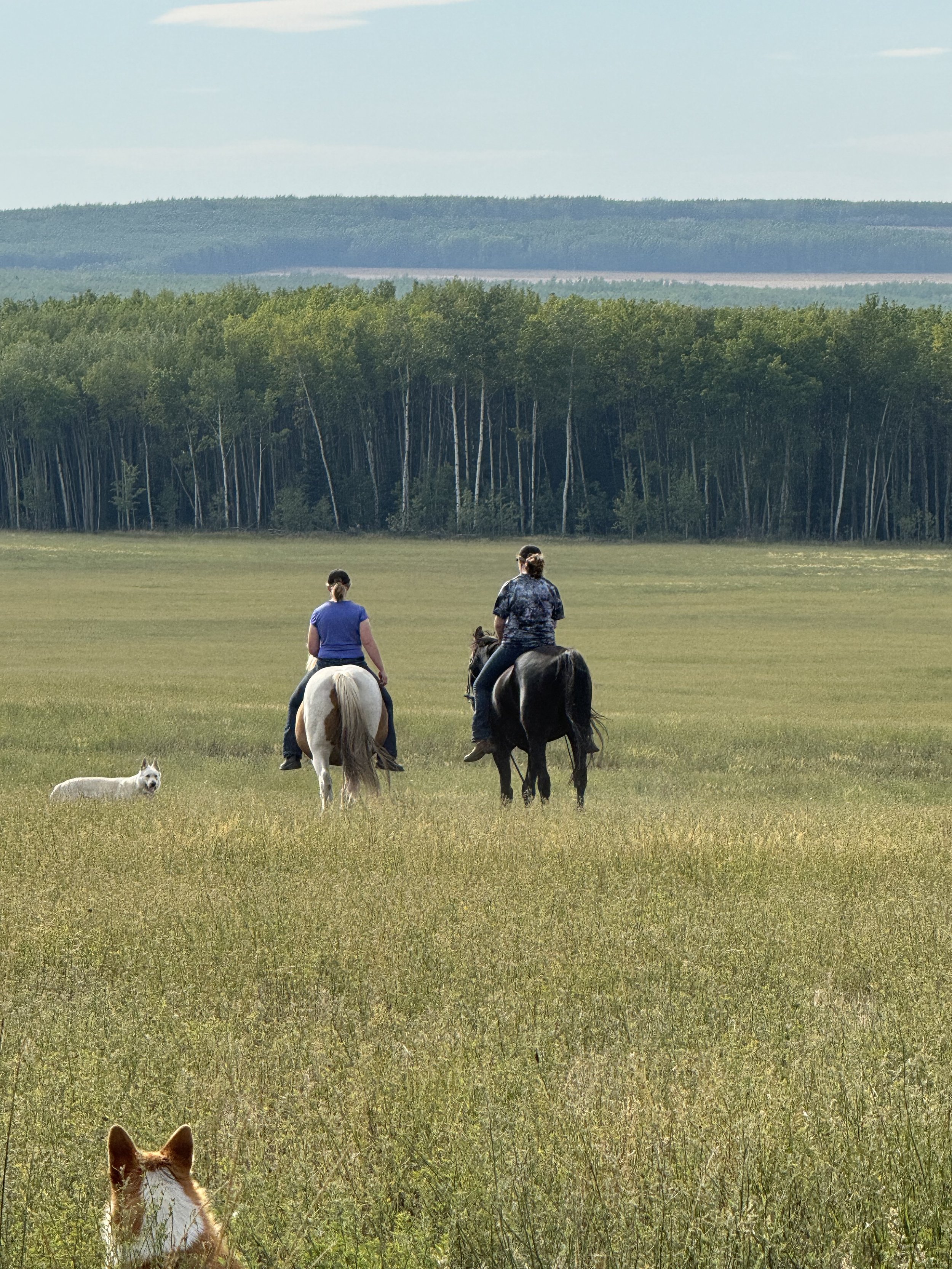
Twice, my plans for one horse were interrupted. Both times, a year later, a black foal stood beside her.
Twice, my plans for one horse were interrupted.
The first time, she was beginning her training.
The second time, she was supposed to be retired.
Both times, I thought the interruption had changed the story for the worse.
Both times, a year later, a black foal stood beside her.
The mare’s name was Domyno.
She was jet-black with a bold white star on her forehead. While she was still young, I had already planned the years we would spend together—riding, chasing cows, and exploring the river hills.
Then one night, the neighbour’s stallion got out.
In the morning, we discovered which mare he had chosen.
Domyno.
I was devastated.
Three years of planning. Dreaming.
Gone.
Or at least, that’s what I thought.
For a few minutes, my emotions churned, and I couldn’t approach Domyno. I didn't want to take my frustration out on her; it wasn't her fault. I eventually picked up a brush and started to groom her. The rhythmic brushing helped me come to terms with what occurred. We would face whatever came next together.
Still, I hoped there would be no baby.
As the months passed, her belly grew larger and rounder. By spring, there would be a foal.
Domyno gave birth to a black colt with a bold white blaze and white socks.
We named him Indee.
I waited impatiently for Domyno to raise her colt so that we could wean him, and she and I could get back to the business of riding. At the time, Indee seemed more like an interruption than a gift.
I had no idea what he would become.
He grew into one of our family’s main riding horses, excelling especially at cattle work. He could stop a cow in its tracks with a flick of his tail while quietly guiding another toward a different gate with the angle of his neck.
Even now, Indee loves to play tag before he is caught. Bring out a cookie, though, and the game quickly becomes “Feed me another one.”
Eighteen years after Indee was born, Domyno was retired. I had decided to let her spend the rest of her days peacefully on the ranch.
Then our stallion got out, and a small group of horses escaped with him.
Including Domyno.
Once again, I was concerned.
By then, Domyno was twenty-one. She had proven herself to be an exceptional mother. My concern wasn’t that she couldn’t raise another foal.
It was that she had already done enough.
After years of riding and raising foals, she had earned a quiet retirement.
Now, once again, my plans changed.
Over the next year, I watched her closely, giving her extra oats and hoping she wouldn’t foal again.
But once again, her belly grew round.
Spring would bring another baby.
Exactly one year after the horses got out, Domyno gave birth to a jet-black filly.
We named her Esperanza, the Spanish word for hope.
Now, five years after Esperanza’s birth, Domyno is twenty-seven, with grey flecks in her hair. She is doing well.
Indee is semi-retired.
They spend their days resting and grazing together. If we take Indee out for a ride, Domyno waits at the gate for him. When he returns, her whinny is the first thing to greet him.
These days, when I go looking for Domyno, I almost always find Indee nearby, grazing quietly beside her.
Esperanza isn’t far away, growing into the next chapter of the story.
Neither of them was supposed to be part of this story.
I can’t imagine it without them now.
Bambi
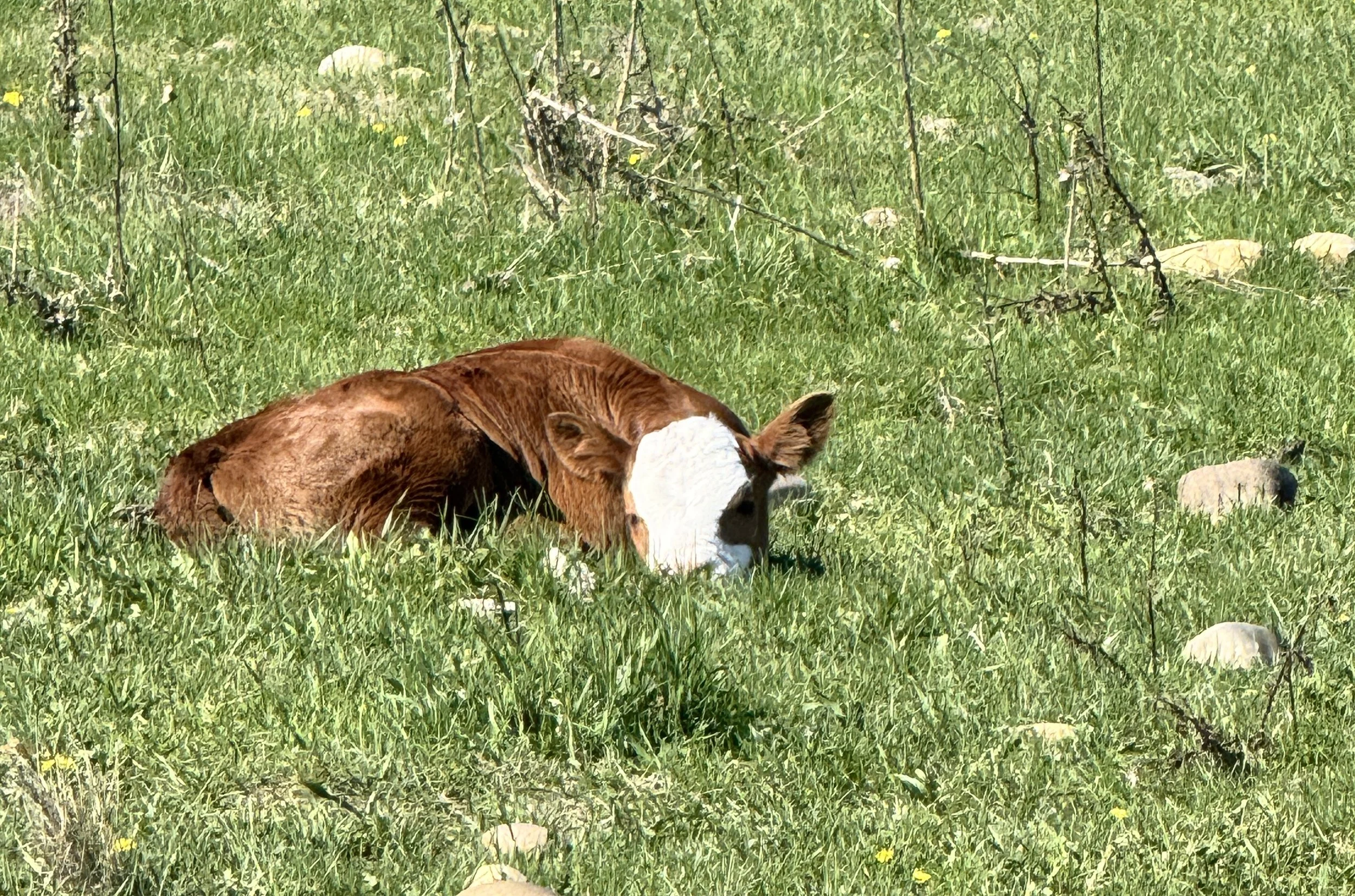
One night, coyotes came through the pasture. By morning, one small calf was still alive, but badly wounded.
The coyotes’ shadows blended with the night as they traveled in single file on a well-worn path.
With silence, stealth, and gnawing hunger.
At the edge of the forest, hidden among the shrubbery, they paused. Surveying the landscape before them, they sniffed the air for the scent of newborn calves.
Their attention settled on a cow and calf sleeping near the edge of the herd, which rested quietly in the open pasture. With the nimble skill of seasoned hunters, the coyotes spread out—crouching low, surrounding their target.
At the leader’s signal, they shot forward and attacked.
The calf cried out, and the silence was shattered. Mother cows leaped to their feet, calling their calves to their sides. At the edge of the forest, one brave mother charged the predators. Fearless and feral, she lowered her head and rushed at the coyote that had sunk its teeth into her calf’s back leg.
The calf bawled—a desperate cry for help.
Three more cows hurtled into the fray, each targeting a member of the hunting pack. The battle was intense but short. The coyotes were turned back.
As the chaos settled, calves pressed close to their mothers, who stood guard. Alert. Watchful. Ready.
When the coyotes didn’t return, the herd grew still.
All seemed well.
Until it wasn’t.
When we found the calf the following morning, his sides were drawn in. When he lifted his head, his ears drooped, and his nose was cracked with dryness. His body bore scratches from the skirmish. We brought him to the barn to rest and rehydrate, hoping to return him to his mom once he recovered.
But he struggled to eat.
When we fed him from a bottle, much of the milk dribbled off his chin and onto the floor. At first, we assumed he needed time to adjust to bottle feeding—but as the struggle continued, we knew something else was wrong.
When we looked inside his mouth, we were startled by what we found. A piece of his tongue was gone, the edge marked by the unmistakable shape of a coyote’s bite. The remaining portion had swollen to nearly three times its normal size.
We transferred the milk from the bottle into a stomach tube, which allowed us to deliver it directly to his stomach.
We named him Bambi.
With a full stomach of warm milk, Bambi lay down and slept.
As his strength returned, we tried the bottle again. At first, feeding Bambi was slow. He mouthed the nipple awkwardly, milk slipping from his chin as he worked to drink without a full tongue. Little by little, he learned to mimic the sucking motion by moving his jaw instead.
After two days, he drank from the bottle, finishing it in minutes.
Through it all, Bambi never made a sound. The damage to his tongue seemed to have affected his voice as well.
But then, one morning, he let out a bright, cheerful call when we brought his bottle.
He had found his voice.
After finishing his milk, he ran around the yard—bucking with pure delight. That summer, Bambi stayed close to the yard, growing stronger by the day. In time, he became a herd sire, fathering calves of his own on the ranch.
Maybe that’s what hope looks like.
One small life.
Changed, but still moving forward.
With what remains.
One day at a time.